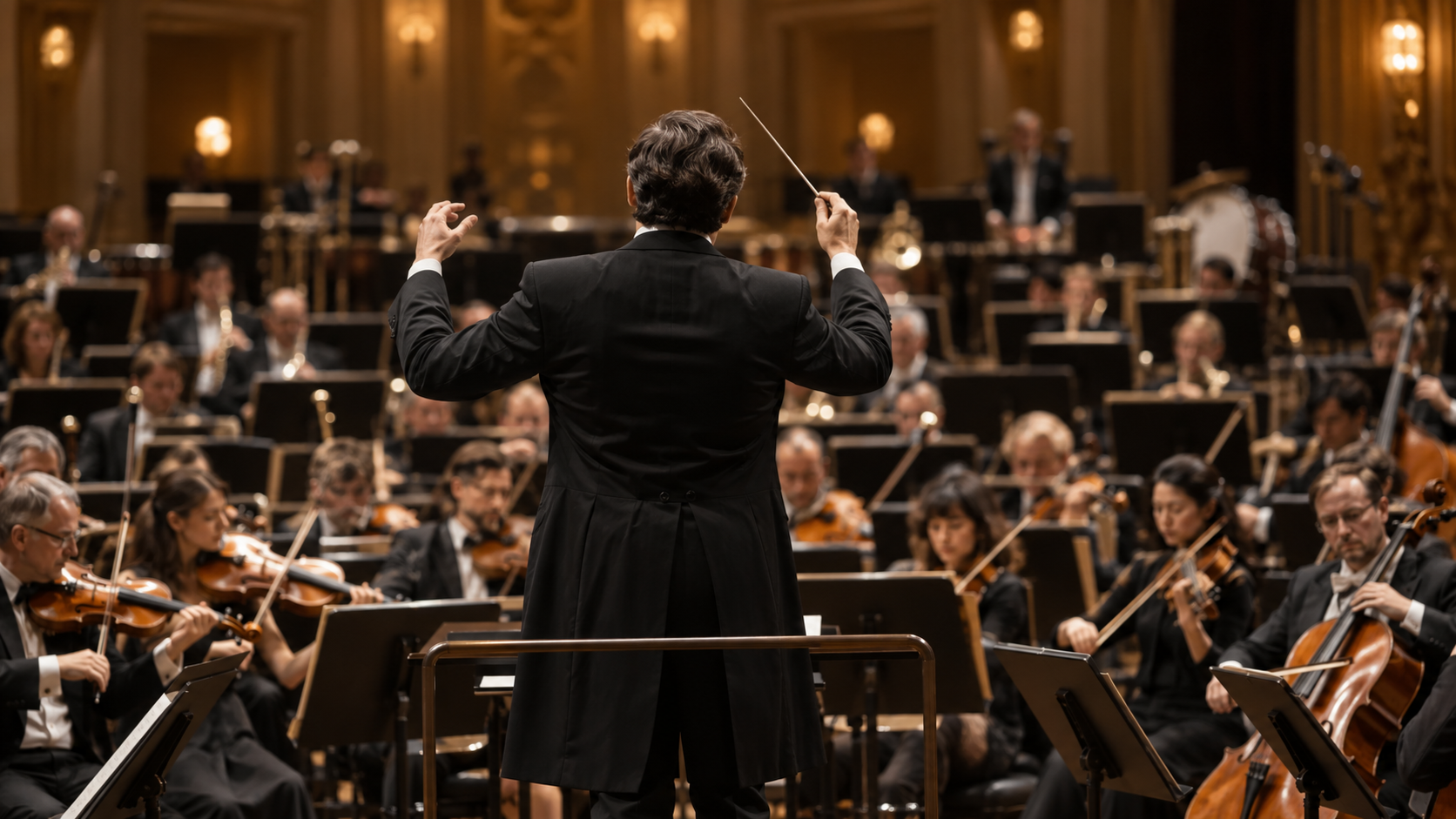
As enterprises move from individual AI agents toward systems of specialised autonomous agents, intelligence alone is no longer enough. The harder question is how those agents coordinate, respond to failure, interact with people and continue working toward a shared objective. Multi-Agent Systems bring distributed capability. Orchestration helps turn that capability into coordinated performance.
Imagine attending a concert where a single musician is expected to play the drums, bass and guitar while also singing all at the same time.
Even an exceptionally talented performer would eventually reach a limit. As the tempo increases and the complexity of the performance grows, coordination becomes harder. A missed beat or dropped instrument could disrupt the entire performance.
Now consider a world-class ensemble.
Instead of depending on a single performer, the ensemble brings together musicians with different skills and responsibilities. The bassist responds to the pianist. The saxophonist follows the rhythm. Each musician contributes independently, yet their performance depends on continuous coordination.
At the centre is an orchestrating function that helps the ensemble remain aligned coordinating timing, direction and interaction without necessarily performing every part itself.
This provides a useful way to think about Multi-Agent Systems, or MAS.
Rather than depending on one central program to perform every task, a Multi-Agent System distributes work across multiple autonomous software agents. Each agent can make decisions, perform specialised tasks and respond to its environment. Collectively, the agents communicate, coordinate and collaborate toward a shared objective.
The strength of the model comes from distributed capability.
Its complexity comes from coordinating that capability.
Understanding Multi-Agent Systems
MAS Definition
A Multi-Agent System consists of multiple agents interacting with one another and sharing information or resources to achieve a common objective. Each agent can have its own responsibilities, decision-making capabilities, behaviours, information, objectives and specialised capabilities. Agents can range from relatively simple software entities to more sophisticated autonomous systems.
Much like members of an ensemble, different agents can contribute different forms of expertise. The value of the system therefore does not come simply from the capability of one agent, but from how effectively the agents combine their individual capabilities.
This distributed model gives MAS an important characteristic: autonomy
The Autonomous Agent
An autonomous agent can make decisions and perform actions without requiring continuous external direction. Within a Multi-Agent System, individual agents can operate independently within their assigned responsibilities while adjusting their actions according to their environment, available information and goals. Several characteristics define this autonomy.
Self-directed
An autonomous agent can determine and execute actions without requiring constant instruction. Like an individual musician responsible for their own part of a performance, the agent operates within its area of responsibility while contributing toward the broader objective.
Adaptive
Agents can alter their behaviour in response to changing circumstances. As a musician adjusts their performance according to the rhythm or behaviour of other members of an ensemble, an autonomous agent can respond to changes in its operating environment.
Proactive
An autonomous agent does not necessarily need to wait for every action to be explicitly requested. It can anticipate situations and take steps toward achieving its goals.
Self-organising
Agents can adjust their behaviour and interactions as conditions change. This ability to operate dynamically makes autonomous agents useful in environments where every possible situation cannot be predetermined.
But autonomy also introduces a fundamental challenge:
How do multiple independently acting agents continue to operate as one coherent system?

Autonomy Without Coordination Can Create Complexity
Coordination Problem
Building a successful Multi-Agent System is not simply a matter of assembling several intelligent agents and assigning them a common objective.
The interactions between agents introduce significant engineering and operational trade-offs.
An ensemble without coordination can quickly become a collection of musicians playing different pieces at the same time.
The same principle applies to MAS.
Agents may individually behave correctly while their collective interaction produces an unexpected result. Communication can become excessive. Agents can spend significant computational effort exchanging information, synchronising decisions and negotiating with each other rather than completing their actual tasks.
Unexpected interactions can also introduce unpredictable system behaviour.
Security becomes more complex as well. In a simpler centralised environment, control is concentrated within fewer components. In a distributed agent environment, the compromise or malfunction of one agent may influence other parts of the system.
The challenge therefore becomes more than simply creating capable autonomous agents.
It becomes a question of coordination and control
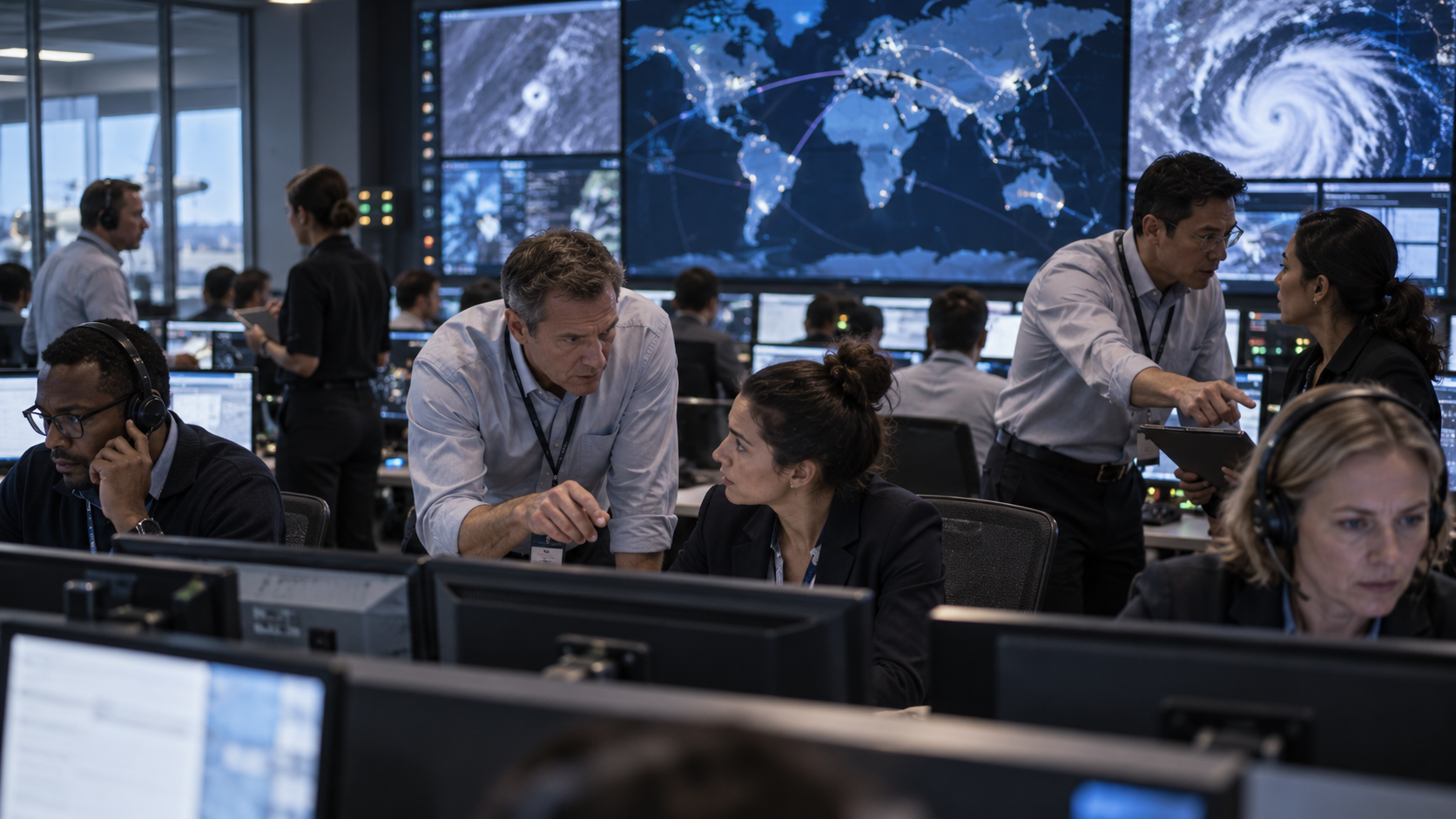
Approaches to Control in Multi-Agent Systems
Control Models
Different approaches can be used to manage agent behaviour.
Centralised Control
A central controller makes decisions for the agents within the system. This approach can create strong coordination, but it may also become inflexible when the environment changes rapidly or when the number of decisions increases.
Decentralised Control
Individual agents make decisions based on local information and their interactions with other agents. This provides greater autonomy and flexibility, but coordination can become increasingly difficult as the number of agents grows.
Hierarchical Control
Agents are organised within a hierarchy, allowing responsibilities and control to be distributed across different levels.
This can provide a balance between central coordination and local autonomy.
Each model presents advantages and trade-offs.
Too much central control can reduce the flexibility that makes autonomous agents valuable.
Too little coordination can make collective behaviour difficult to manage.
This is where the role of an Orchestrator Agent becomes important.
The Orchestrator Agent
Orchestrator Definition
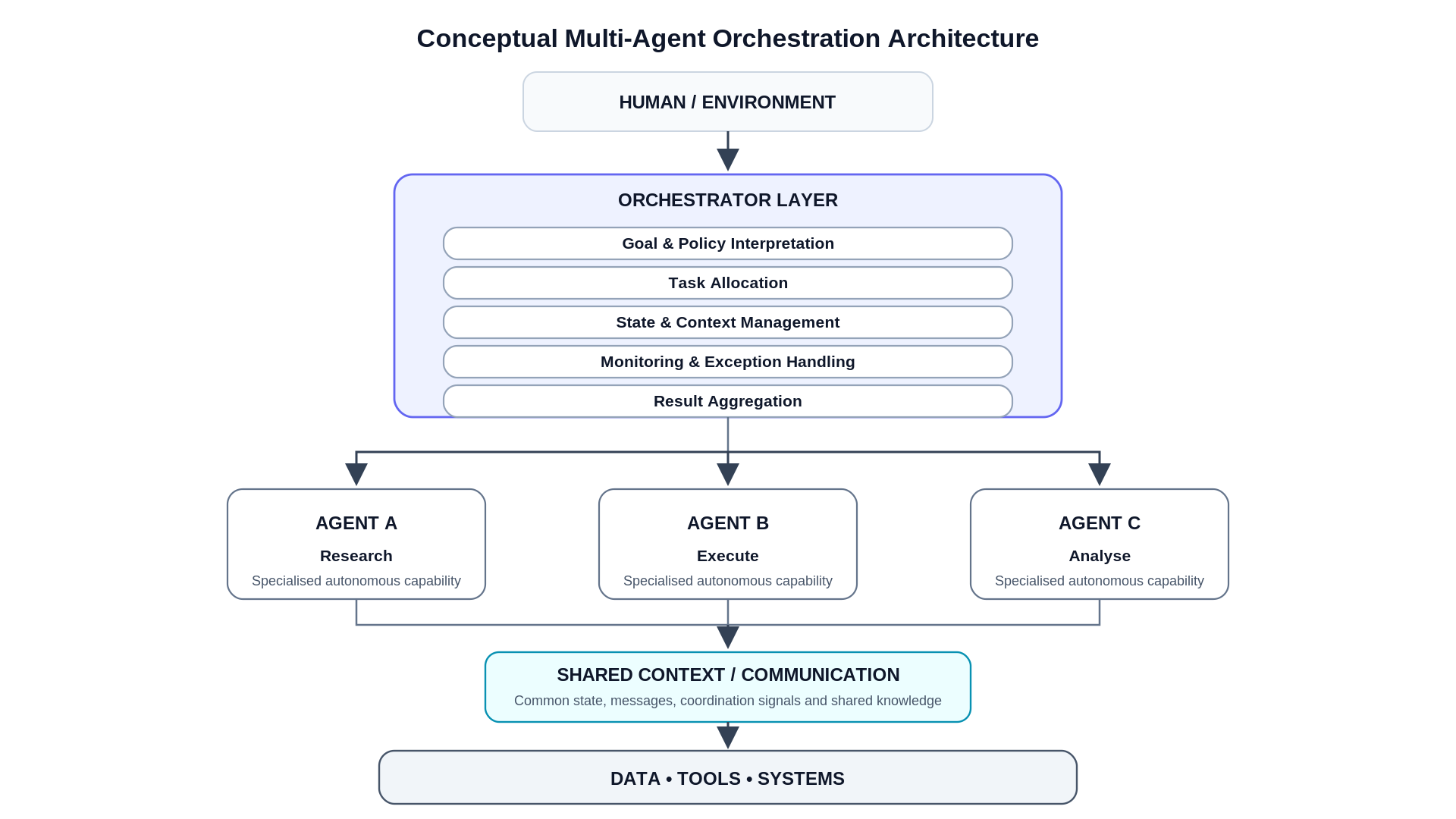
An Orchestrator Agent coordinates and manages the activities of other agents within a Multi-Agent System.
The musical analogy is particularly useful here.
An orchestra conductor does not personally play every instrument. Instead, the conductor helps ensure that individual musicians perform at the appropriate time, respond to one another and remain aligned with the overall composition.
Similarly, an Orchestrator Agent can help coordinate autonomous agents while still allowing them to perform their own specialised tasks.
Its responsibilities can be understood across three broad areas.
Coordination
The orchestrator helps ensure that individual agents perform the appropriate activities at the appropriate time in support of the common objective.
Management
It can manage priorities, assignments and interactions between agents so that individual actions remain aligned with the wider system.
Control
Where necessary, it can influence agent behaviour to maintain coordination, particularly when failures, exceptions or conflicts occur.
The objective is not simply to reduce autonomy.
It is to ensure that distributed autonomy produces a coherent outcome

Autonomy creates capability. Orchestration turns that capability into coordinated performance. The challenge in a Multi-Agent System is not simply making individual agents intelligent. It is ensuring that distributed intelligence produces a coherent system-level outcome.
Managing Failures and Exceptions
Failure Management
One of the most important responsibilities described for the Orchestrator Agent is the management of failures and exceptions.
Consider an agent that becomes unavailable or fails to complete its assigned task.
Without coordination, that failure could interrupt a wider process.
An orchestrator can identify the failure and initiate an alternative response for example, redirecting the task to another agent or invoking an available backup mechanism.
The same principle can apply when an agent begins behaving differently from what the system expects.
The orchestrator can monitor system behaviour, detect deviations and take corrective action.
Where multiple agents are affected simultaneously, coordination becomes even more important. The system may need to redirect work, redistribute activity or temporarily change how tasks are executed.
Orchestration therefore provides an important mechanism for maintaining system stability, reliability and continuity when individual components fail.
Learning and Adaptation
Adaptive Orchestration
The orchestration layer may also improve its behaviour over time.
In such a model, the orchestrator can learn from previous system situations and use those experiences when making future decisions. This may include analysing information generated by the Multi-Agent System, identifying patterns in previous outcomes and adjusting its behaviour.
Human feedback can also contribute to this learning process.
If operators identify an undesirable outcome or provide guidance following a decision, that feedback can inform how the orchestrator responds to similar circumstances later.
The underlying principle is straightforward:
Coordination does not necessarily need to remain static.
As the system encounters new situations, its orchestration mechanisms can also adapt. However, autonomy and adaptation do not eliminate the role of people. Some decisions may remain sufficiently important that human judgement is still required.
Human-to-Agent Control Transfer
Human Oversight
As Multi-Agent Systems become more autonomous, the relationship between human operators and agents becomes increasingly important.
The source describes this through the idea of human-to-agent control transfer.
An Orchestrator Agent can support this relationship by helping human operators understand what is happening within the system and by coordinating the execution of decisions.
Two functions are particularly important.
Providing Context
Human operators need sufficient context before they can make informed decisions.
The orchestrator can provide information concerning:
• the current state of the system; • system performance; • errors or warnings; • relevant agent activity; and • the objective associated with a particular decision.
Without this context, human intervention risks becoming disconnected from what the agents are actually doing
Issuing Commands
Once a decision has been made, the orchestrator can communicate the required action to the relevant agents and coordinate its execution.
Human operators therefore remain capable of influencing system behaviour without needing to individually direct every agent.
This creates a relationship in which humans provide direction, judgement or intervention while the orchestrator manages the coordinated execution of that direction

How Humans Can Influence Orchestrator Decisions
Human Decision Mechanisms
Human control can be incorporated into the system in several ways.
First, humans can define rules governing how the orchestrator should respond to particular situations. These rules represent knowledge and expectations about how the system should behave.
Second, decision-making models can be defined to help the orchestrator adapt its responses according to the behaviour and information generated within the system.
Third, human operators can intervene when critical decisions require judgement.
They can review system behaviour, provide feedback and influence how the orchestrator handles similar situations in the future.
Together, these mechanisms allow autonomy to coexist with human oversight
Agent-to-Agent Coordination
Agent Coordination
Coordination is equally important between agents.
The success of an ensemble depends not only on the ability of individual musicians but also on their ability to perform together.
The same is true of Multi-Agent Systems.
Two important orchestration functions can support this interaction.
Sharing Information
The Orchestrator Agent can help ensure that agents receive the information they need to maintain a common understanding of the system.
This reduces confusion and helps individual agents align their actions with the broader objective.
Synchronising Actions
Some tasks depend on activities occurring in a particular sequence or at a particular time.
The orchestrator can coordinate these activities so that agents do not act independently in ways that undermine each other.
Agents therefore retain autonomy over their individual activities while their interactions remain coordinated at the wider system level.
This distinction is important.
Autonomy does not have to mean isolation
Individual agents can remain independently capable while still participating in a coordinated system.
Designing for Failure
Resilience
A Multi-Agent System must also consider what happens when an agent becomes unavailable.
The source proposes the use of backup mechanisms that allow another agent or capability to temporarily assume the responsibility of a failed component.
Such mechanisms can improve several aspects of the system.
Continuity
Work can continue even when an individual agent becomes unavailable.
Reliability
The failure of a single component does not necessarily cause the wider system to stop operating.
Availability
Alternative capabilities can be activated while the original agent is restored.
The same principle applies to the Orchestrator Agent itself.
Because orchestration plays such an important coordinating role, failure of the orchestrator could have significant consequences.
The article therefore identifies the possibility of a secondary orchestrator taking over when the primary orchestration capability becomes unavailable, or of the system entering a controlled state until normal operations can be restored.
Emergency rules can also be established to prevent uncontrolled behaviour during such situations.

From Individual Intelligence to Collective Performance
Conclusion
Multi-Agent Systems represent a different way of approaching complex problems.
Instead of depending exclusively on a single component to manage every decision, responsibility can be distributed across multiple autonomous agents with different capabilities.
Each agent can contribute specialised intelligence and perform its own tasks.
But the value of the system ultimately depends on something larger than the intelligence of those individual agents. It depends on their ability to operate together.
This is where orchestration becomes important.
The Orchestrator Agent helps coordinate activity, manage interactions, provide system context, respond to failures and connect autonomous execution with human oversight.
The orchestra analogy therefore reveals an important principle.
A world-class performance is not created merely by assembling talented musicians.
It emerges when individual capability is combined with effective coordination.
The same principle applies to Multi-Agent Systems
Autonomy creates capability. Orchestration turns that capability into coordinated performance.
As systems become increasingly distributed and agents assume greater responsibility for independent action, the challenge will not simply be creating smarter agents.
It will be ensuring that those agents can work together reliably, coherently and in support of the objectives the system was designed to achieve.
Preparing for an agentic enterprise?
As autonomous agents begin to participate in more complex enterprise processes, architecture, governance and operating-model decisions become increasingly interconnected. Zakhya helps organisations evaluate how emerging AI capabilities can be introduced within the wider context of enterprise transformation, technology architecture, governance and value