
Technology creates value not merely through what it adds, but through what it allows the enterprise to stop doing.
Connectivity is crossing an important threshold
For years, inflight connectivity was largely treated as a technology and passenger-experience decision.
How fast is the connection? How reliable is it? What will installation cost? Should passengers pay for Wi-Fi? Which aircraft should receive it first?
Those remain valid questions.
But they are becoming the wrong boundary for the decision.
The arrival of high-performance, low-Earth-orbit satellite connectivity is changing what is technically possible inside an aircraft. Passengers can increasingly experience a digital environment much closer to the one they expect on the ground: communication, streaming, gaming, cloud applications and real-time transactions.
And deployment is moving beyond experimentation.
In August 2026, Qatar Airways reported that 150 of its widebody aircraft were equipped with Starlink and that more than 23 million passengers had connected to the service since its launch in October 2024. SAS completed Starlink installation across all 81 aircraft in its Airbus A320neo fleet in September. United has similarly been undertaking one of the largest airline Starlink deployments.
The strategic importance of that shift is not simply better Wi-Fi.
It is what persistent, high-performance connectivity can allow an airline to change elsewhere in the business.
That distinction matters because some of the greatest value created by technology does not arise from what the technology itself does.
It comes from: what the organisation no longer needs to do in the same way once the technology exists.
For airline CEOs, that opens a much broader conversation.
The wrong question is: what is the return on connectivity?
Imagine an airline evaluating next-generation inflight connectivity as a conventional technology investment.
Management might compare installation and operating costs with passenger satisfaction, loyalty benefits and potentially connectivity revenue. That produces a legitimate business case. It may also materially underestimate the opportunity.
Once reliable high-bandwidth connectivity becomes an assumed part of the aircraft, a different set of questions becomes possible.
- Does every aircraft need the same entertainment architecture?
- Does every passenger need dedicated entertainment hardware?
- How much content must the airline itself acquire and distribute?
- Could some of today's fixed cabin infrastructure become digitally delivered services instead?
- Could connectivity support commerce, loyalty, customer service and disruption management while the passenger remains airborne?
- Could the network also enable better crew tools and operational services?
- Could different cabin architectures affect aircraft weight, power, maintenance, lifecycle cost and sustainability?
These questions belong to different organisational functions.
And that is precisely the problem.
A CIO can make a good connectivity decision. A customer director can make a good entertainment decision. Procurement can make a good content decision. Engineering can make a good cabin-equipment decision. Sustainability can make a good environmental decision. Finance can make a good capital-allocation decision.
And the airline can still miss the larger opportunity because:
No single functional decision captures the economics created between them.
When that happens, the technology business case is too small.
From connectivity to enterprise value
From hardware differentiation to digital enablement
For decades, airlines differentiated significant parts of the onboard experience through hardware.
The screen, entertainment system, cabin electronics and content library were part of what the airline itself had to assemble and carry in order to create a differentiated digital experience at altitude.
The industry continues to improve that model.
Newer-generation inflight entertainment architectures are increasingly being designed to reduce weight, power consumption and lifecycle complexity, while using more modular components that can be upgraded without replacing the entire system. These improvements matter, but they still optimise the existing model rather than question whether every element of that model remains necessary in a permanently connected aircraft.
Those improvements matter.
But ubiquitous connectivity introduces a more fundamental question.
Instead of asking: How do we make the existing entertainment architecture more efficient?
Airlines can increasingly ask:
-
Which elements of that architecture still need to exist in their current form? That shifts the conversation from hardware optimisation toward digital enablement and operating-model design.
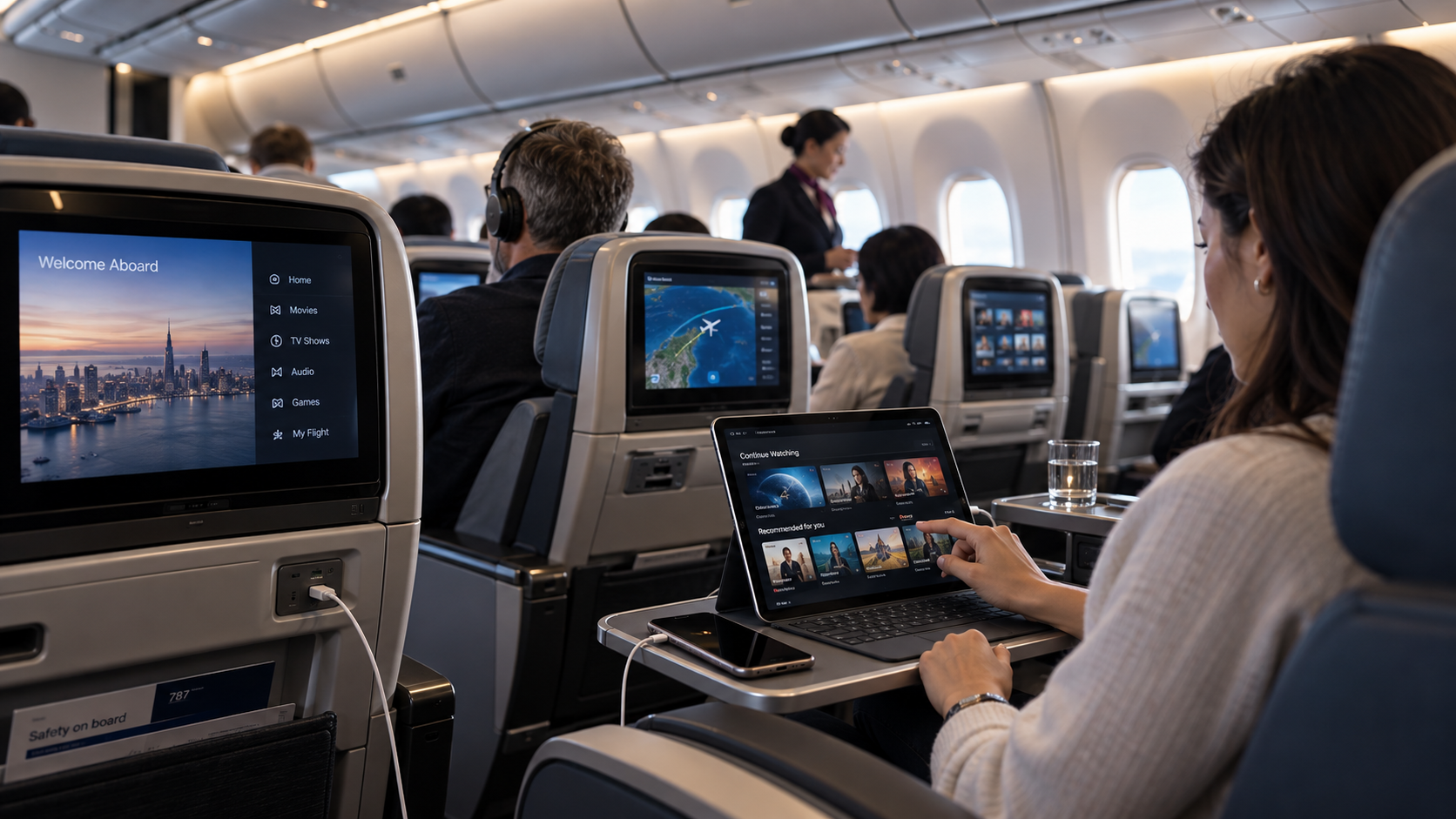
A passenger already arrives with a sophisticated digital environment.
They bring a smartphone, tablet or laptop. Their applications. Their preferences. Their identity. Their subscriptions. Their payment credentials. Their communications. Increasingly, their workplace.
Connectivity can allow the airline to enable more of that environment rather than reproduce all of it.
The strategic question therefore becomes:
What should the airline own, what should it enable, and what can the passenger or a partner already provide?
Technically replaceable does not mean strategically unnecessary
This does not mean seatback entertainment is about to disappear.
Indeed, one of the most useful counterexamples comes from United.
While rapidly deploying Starlink, United is simultaneously expanding embedded entertainment and seatback displays. That illustrates the strategic issue well.
A premium long-haul carrier may decide that a large integrated display remains an important part of its brand and customer proposition.
A short-haul airline may reach a very different answer.
A low-cost operator may find a personal-device-led architecture entirely consistent with its economics.
Different cabins within the same aircraft may justify different choices.
So the opportunity is not: Remove everything connectivity makes technically replaceable.
It is: Determine what the airline should continue to own deliberately.
That is strategy, rather than cost reduction
Technology can make an asset replaceable. Strategy determines whether it should actually be replaced.
Content economics could change as well
Connectivity also challenges another established component of the cabin proposition: content.
Historically, an airline wishing to provide entertainment needed both the infrastructure to display it and an ecosystem for selecting, licensing, preparing, distributing and updating it.
A permanently connected aircraft creates alternative possibilities.
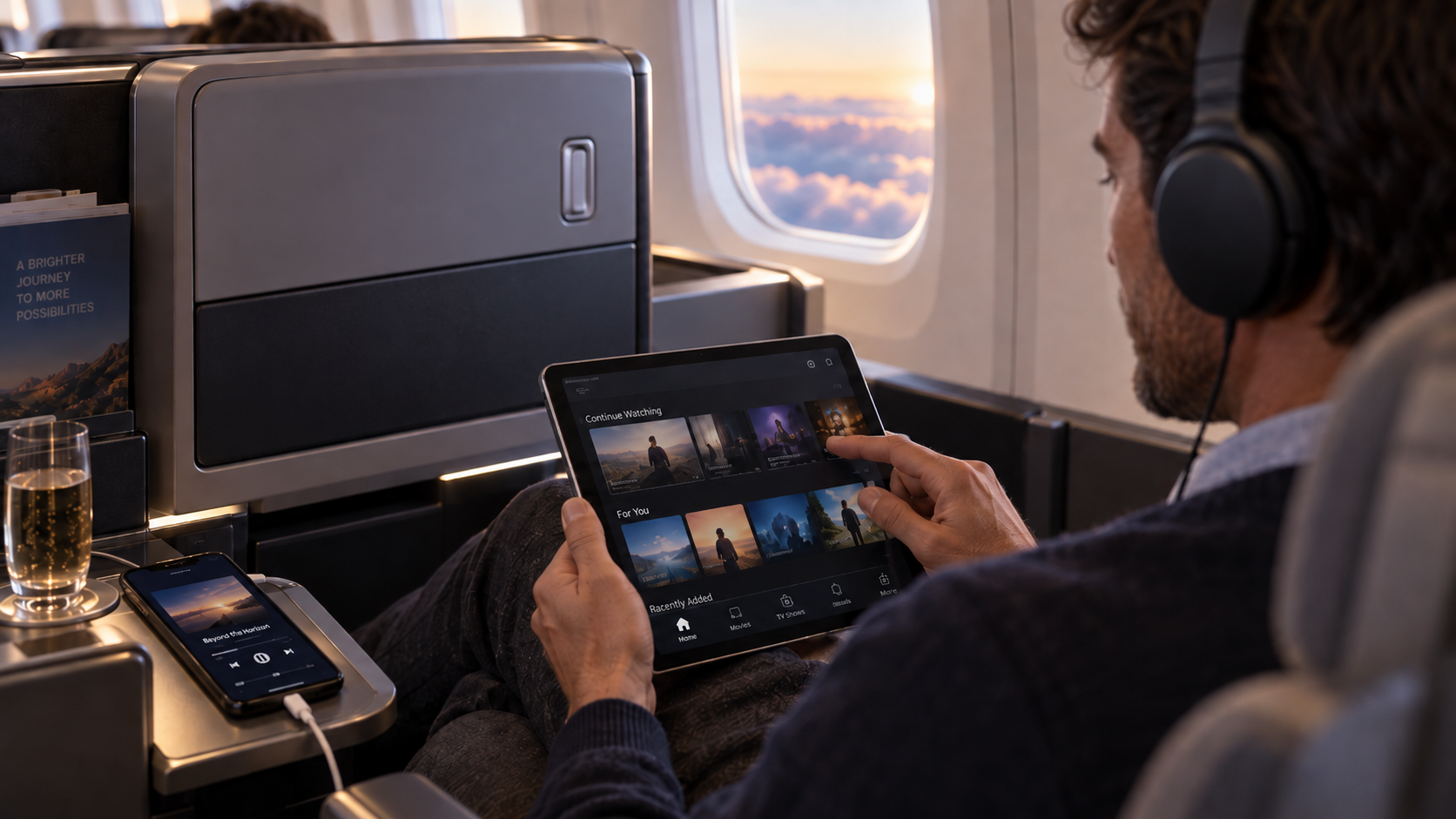
Passengers increasingly arrive with digital subscriptions and entertainment relationships that already exist outside the airline.
That creates an apparently simple economic question: Why recreate a content ecosystem if the passenger already has one?
But the commercial reality is more complicated.
Industry discussions continue around whether consumer streaming subscriptions automatically provide the necessary rights for commercial inflight environments, alongside territorial licensing and public-performance considerations.
That does not weaken the strategic case. It changes it.
The opportunity is not simply: Replace airline content with consumer streaming services.
The better question is: What should the future content model look like when the aircraft is continuously connected?
The answer may be hybrid.
Airline-curated content may remain valuable for premium differentiation, children, accessibility, passengers without subscriptions, destination programming or distinctive brand experiences.
Personal streaming may absorb another part of consumption.
Live content, direct partnerships and new licensing models could create others.
Connectivity therefore has the potential to change not only the cost of content, but also the structure of the content ecosystem itself.

Weight is a financial question before it is a sustainability claim
Physical cabin infrastructure has another characteristic: the aircraft must carry it.
Weight influences fuel consumption, which means changes in cabin architecture can affect operating economics over the lifetime of the aircraft.
But this is an area where broad industry claims can quickly become misleading.
The effect should be modelled by aircraft type, installed equipment, route profile, utilisation, sector length, fleet scale and operating life.
The relevant question is not: How much fuel does removing a screen save?
It is: What are the lifetime financial consequences of changing this aircraft configuration across the relevant fleet and network?
That analysis can include more than fuel.
Equipment must be purchased, installed, powered, inspected, maintained, repaired, upgraded, stocked as spares and ultimately replaced.
Aircraft economics are therefore lifecycle economics.
A relatively small change on one aircraft can become materially different when repeated across hundreds of aircraft, thousands of sectors and many years of operation.
The sustainability case should follow the same discipline.
Reduced fuel use can have an emissions consequence. Fewer electronic components may also affect manufacturing, replacement and end-of-life material requirements.
But those impacts should be calculated rather than assumed.
When digital capability allows physical infrastructure to be reduced, the investment case should include the lifetime economics of the infrastructure no longer required, not merely the cost of the new technology.
Connectivity can become operating infrastructure
There is another value pool that is easily missed if connectivity is viewed only through the passenger experience.
The network can increasingly become part of the operating environment of the cabin.
That does not mean mixing passenger connectivity with safety-critical aircraft systems. Network segregation, security architecture, certification and operational controls remain essential.
But appropriately designed connectivity can support a wider ecosystem of digital services.
Crew can receive more timely operational information.
Customer-service context can become available during the flight rather than after landing.
Disruption information can move between ground operations, crew and passengers.
Selected service and maintenance information can become more current.
Ground-based expertise can potentially become easier to reach when unusual situations arise.
The strategic value of connectivity is therefore not limited to what passengers consume through the network.
It can extend to how the airline itself operates around it.
The bigger prize may be on the revenue side
Cost reduction remains only one side of the equation.
The connected aircraft also creates something airlines have historically struggled to maintain continuously: a digitally active customer relationship throughout the journey.
Traditionally, the aircraft interrupts part of that relationship.
A customer searches, books, checks in, uses airport services and interacts digitally on the ground.
Then, for several hours, much of that commercial and service relationship becomes constrained.
Persistent connectivity changes that.
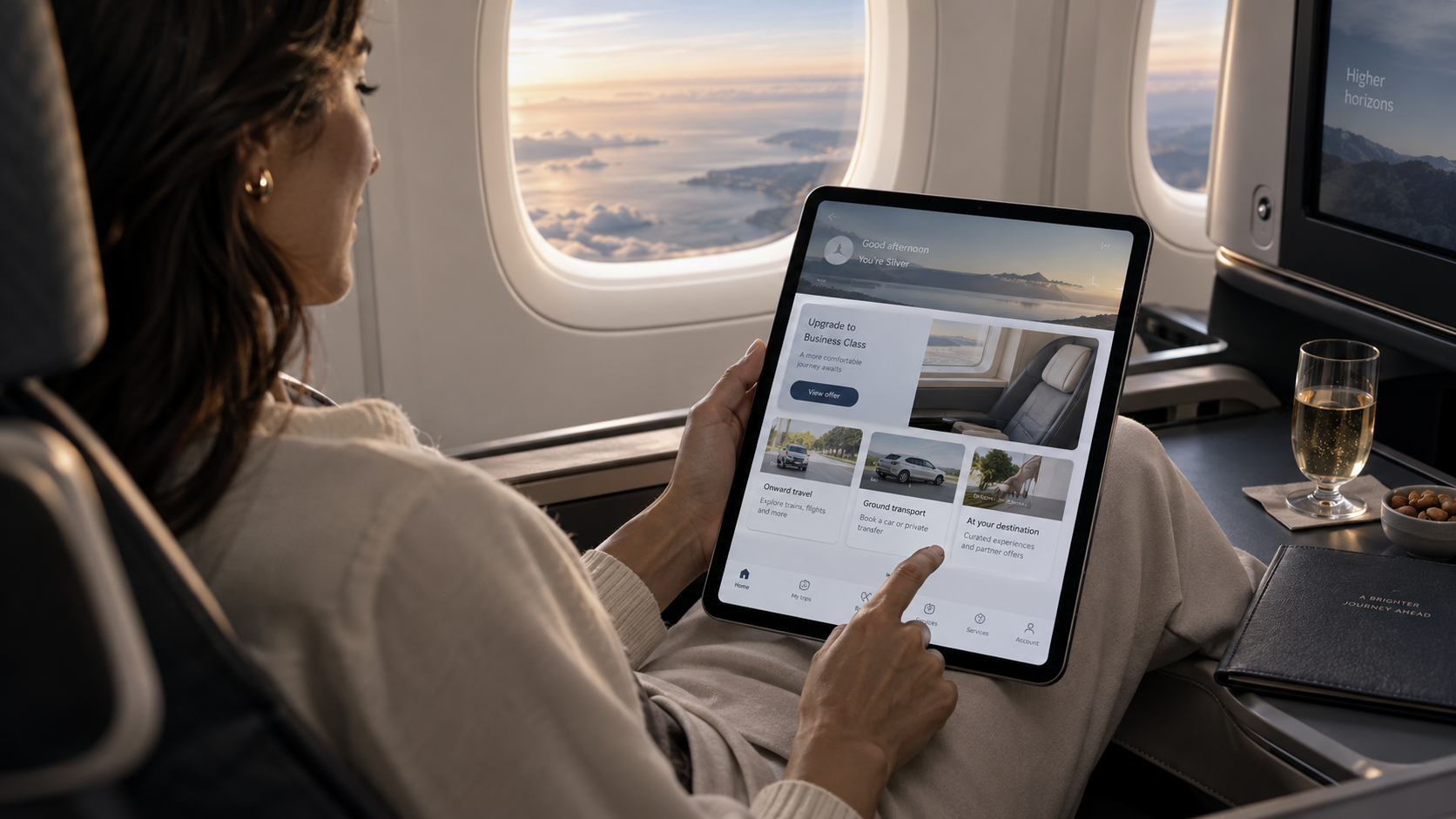
A passenger can potentially manage an onward journey before landing.
An airline can present a relevant upgrade while the journey is still taking place.
Immigration, Clearance, Ground transport, accommodation or destination experiences can be arranged before arrival.
Disruption can be handled earlier.
Loyalty benefits can become more immediate.
Retail can become dynamic rather than catalogue-based.
Commercial partnerships can extend into the cabin.
And customer service need not wait for the aircraft door to reopen.
Connectivity therefore creates a much larger strategic possibility: The aircraft no longer has to be a break in the airline's digital relationship with the passenger.
Booking, airport, cabin, disruption management, loyalty, commerce and destination services can increasingly become parts of a continuous digital journey.
That begins to move the airline from offering isolated digital services toward operating something closer to a digital travel platform.
The executive question consequently becomes less: What does Wi-Fi cost us?
and more: What is the economic value of maintaining a connected, identifiable and potentially transactable customer relationship throughout the journey?
That is a very different business case.
A connected cabin also creates new dependencies
The value case should not ignore what connectivity makes more important.
A personal-device-led proposition assumes that passengers have suitable devices.
Those devices need power.
Accessibility cannot depend entirely on personal technology.
Customers without streaming subscriptions still require an equitable experience.
A more commercially active digital environment raises questions about privacy and appropriate use of customer data.
Greater reliance on connectivity makes resilience and service availability more consequential.
Cybersecurity becomes increasingly important as the number of connected services grows, while passenger-facing and operational environments must remain appropriately segregated.
Supplier concentration and contractual dependency also matter when an increasingly important part of the customer and operating proposition relies on external connectivity infrastructure.
And brand considerations remain significant.
What is technically efficient for one airline may be completely inconsistent with the proposition of another.
These are not reasons to reject the connected model.
They are reasons to distinguish: theoretical value from realisable value
And suddenly the original technology business case looks too small
Put these consequences together and an interesting pattern appears.
A decision that initially concerned satellite connectivity begins affecting:
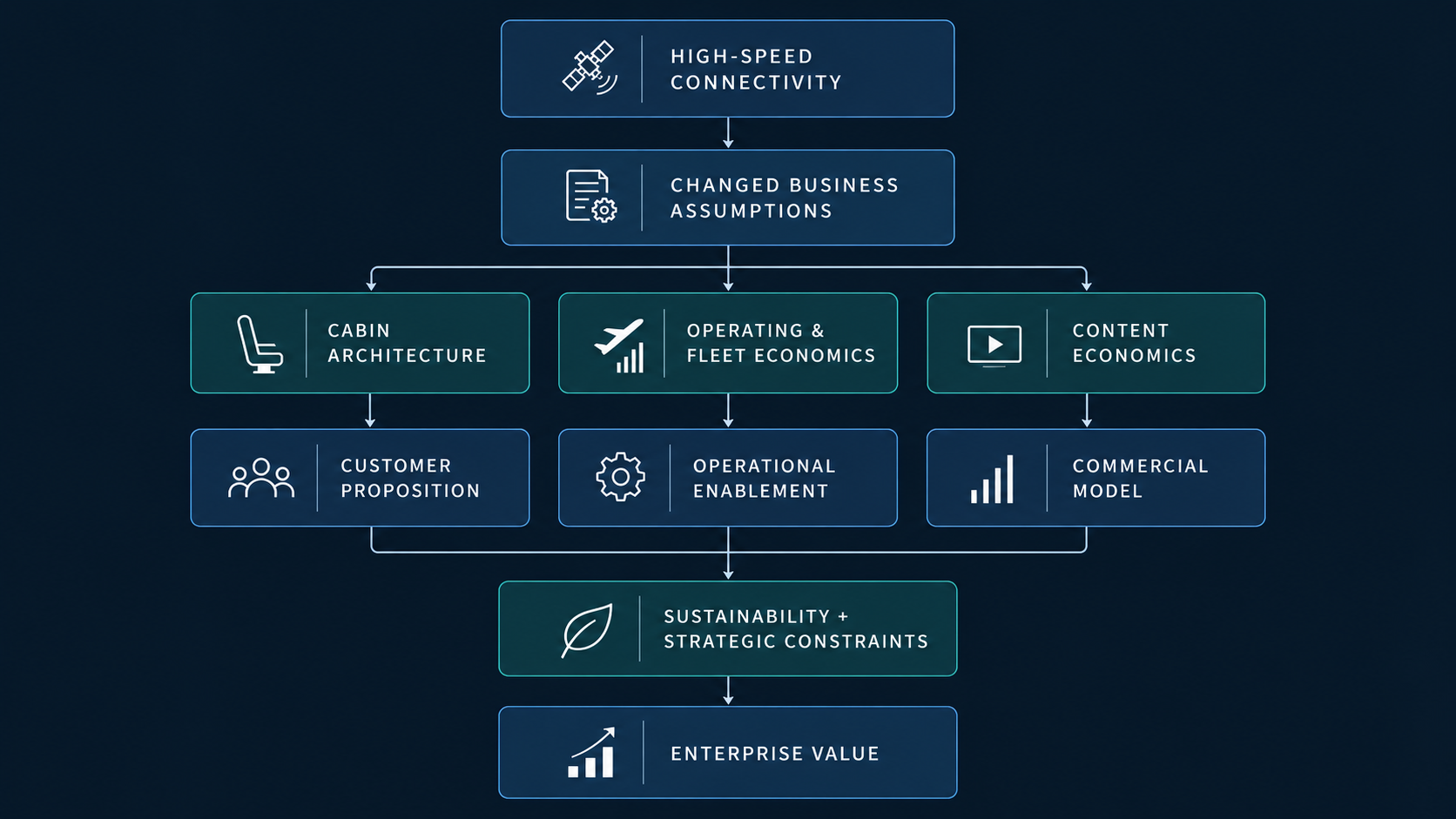
• cabin architecture; • aircraft economics; • maintenance; • capital expenditure; • content rights; • customer experience; • loyalty; • digital commerce; • operational processes; • partnerships; • fuel consumption; • sustainability; • technology architecture; • data; and • brand differentiation.
These are not miscellaneous secondary benefits of an IT project.
They are interconnected enterprise value pools.
And once one decision starts changing several of those pools simultaneously, a conventional functional business case becomes insufficient.
This is the point at which: a technology decision stops being a technology decision.
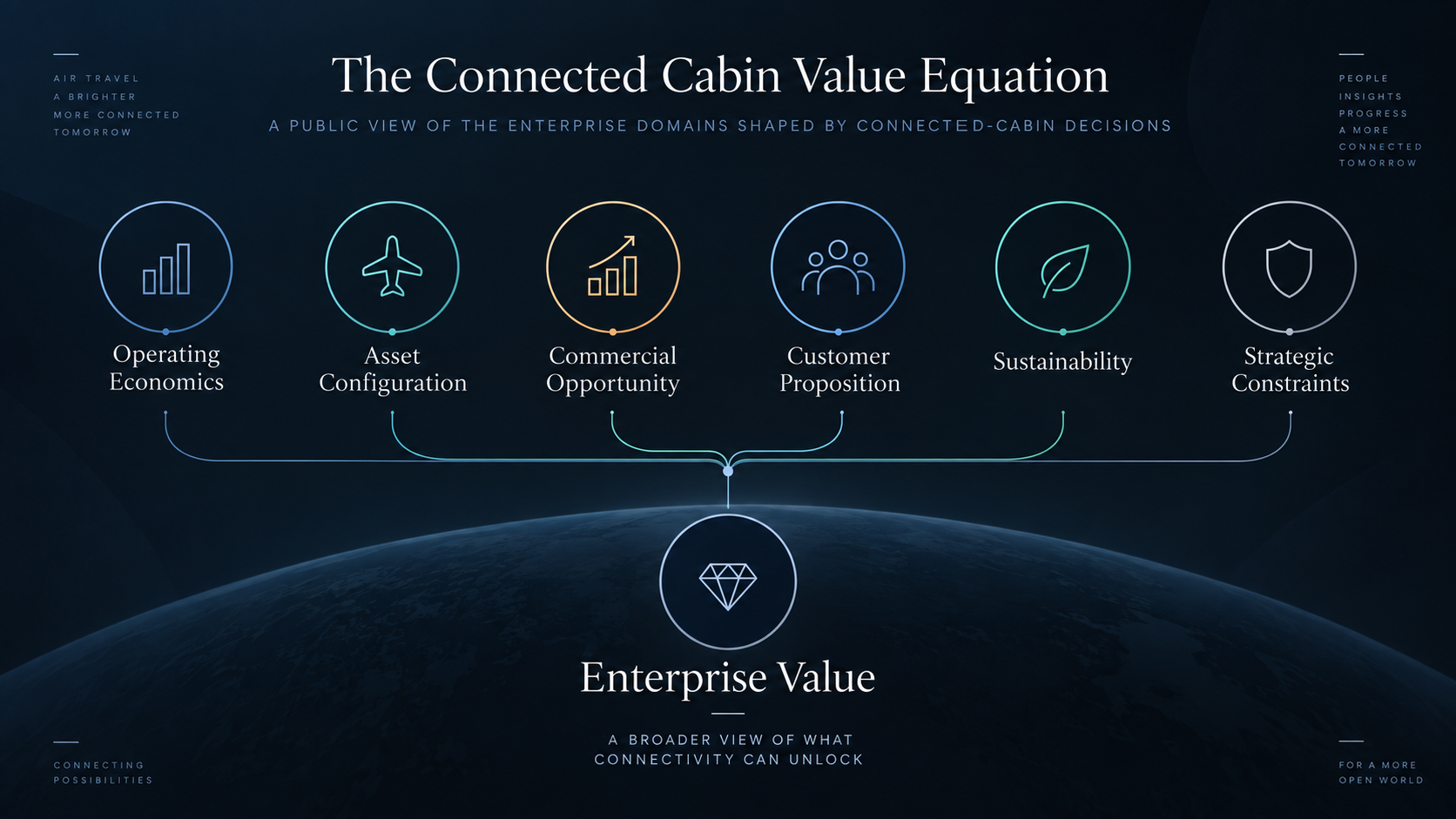
Zakhya Framework: The Connected Cabin Value Equation
At Zakhya, we describe this challenge through the Connected Cabin Value Equation, an executive framework for examining how a change in connectivity can create, remove or redistribute value across an airline rather than evaluating the technology solely inside the function purchasing it.
The framework considers the relationships between:
Operating Economics | Asset Configuration | Commercial Opportunity | Customer Proposition | Sustainability | Strategic Constraints
Its purpose is not to prescribe whether an airline should remove seatback screens, retain embedded entertainment or select a particular connectivity provider.
Those are outcome decisions.
The more important task is to establish the correct boundary of the business case before those decisions are made.
An airline that evaluates connectivity only as connectivity may reach a perfectly rational conclusion while leaving substantial enterprise value outside the analysis.
Discuss the Connected Cabin Value Equation
The implication for CEOs goes beyond aviation
The connected aircraft provides a particularly visible example, but the management problem is not unique to airlines.
Enterprises repeatedly evaluate technology within the organisational function in which it first appears.
Automation is evaluated through labour productivity.
Cloud through infrastructure cost.
Data through reporting.
Digital platforms through IT expenditure.
Connectivity through communications.
AI through process efficiency.
Yet transformational value frequently emerges somewhere else.
A technology may eliminate an activity.
Change the economics of an asset.
Remove an intermediary.
Collapse a process.
Shift responsibility to a customer or partner.
Create a new distribution channel.
Turn a product into a service.
Create new commercial relationships.
Or change which parts of the customer experience the enterprise itself needs to own.
That means executive teams should ask another question alongside the conventional ROI analysis: If this technology works exactly as promised, what else in our business should no longer remain the same?
That question often reveals value that the original investment case never considered.
Technology creates value through subtraction as well as addition
For decades, airlines brought the outside digital world into the aircraft.
Entertainment was stored onboard.
Screens were installed into seats.
Content was curated for the cabin.
Communication diminished after take-off.
Transactions frequently waited for landing.
The connected aircraft starts to reverse that architecture.
Instead of continually recreating the digital world inside the cabin, the aircraft can increasingly become part of the digital world itself.
That does not mean removing every physical component that technology makes replaceable.
Some should disappear.
Some may shrink.
Some can move to passengers or partners.
Some should be redesigned.
And some should be retained deliberately because they remain important to customer experience, revenue or brand differentiation.
Exactly where those boundaries sit will differ between airlines.
But that is precisely why this is a strategy decision.
The wider lesson extends well beyond aviation: The greatest return from a new technology may not come from the capability it adds. It may come from the costs, assets, processes and assumptions it allows the enterprise to reconsider.
For CEOs, that is the moment when the technology decision is no longer a technology decision.
Where is value sitting outside your current business case?
Zakhya works with leadership teams to examine strategic investments across organisational boundaries — connecting technology change with operating economics, asset strategy, commercial models, customer proposition and enterprise value.